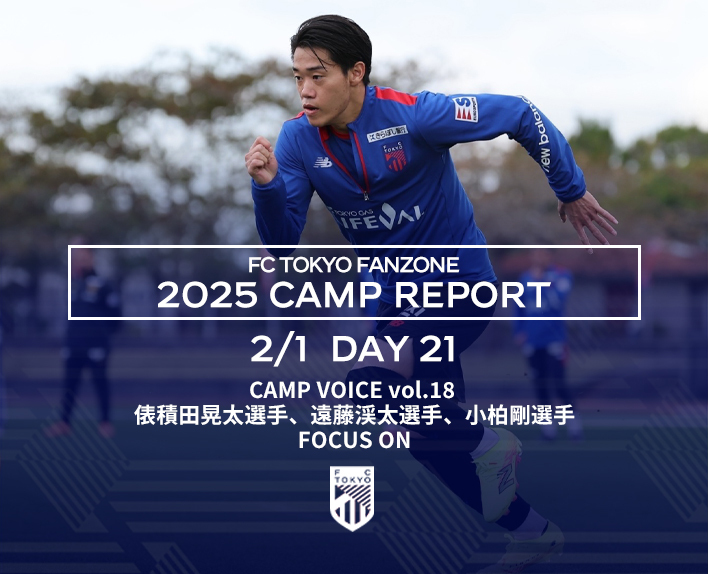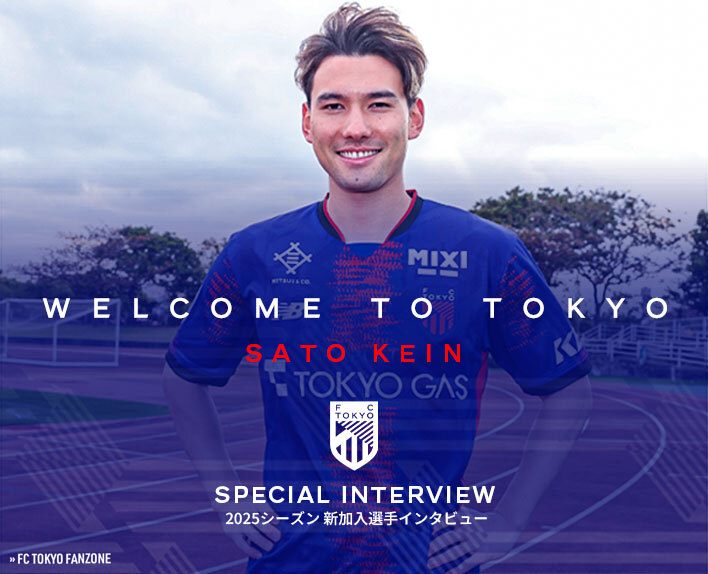


A young attacker returning from Germany has joined the blue-red army currently training in Okinawa. Without waiting to graduate from Meiji University, he moved to Europe and joined SV Werder Bremen. He became a regular in the U-23 Japan national team for the Paris Olympic generation and participated in last summer's main tournament. However, it is also true that he did not play for the first team in Bremen and spent frustrating days. To aim for the top once again and to prove his abilities, he chose to restart in Tokyo, and I heard about his determination.
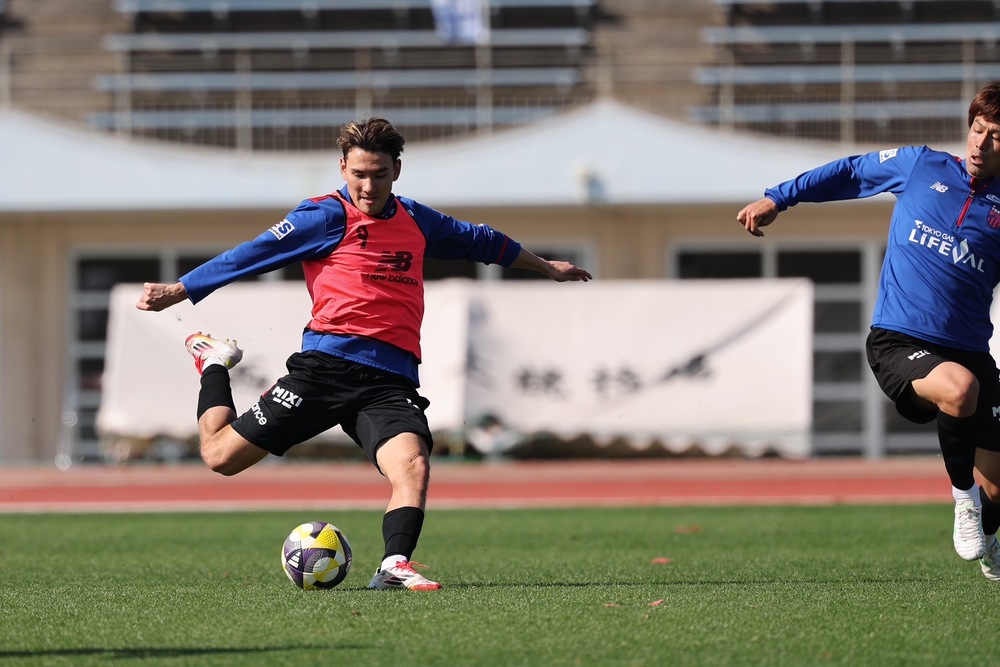
Q: I returned from Germany and joined the Okinawa camp. How is your current condition?
A: I arrived in Okinawa at night, so I still have a bit of jet lag. However, it has been gradually improving, and I think I am doing fine while consulting with the physical coach. Of course, I intend to win the competition and start as a regular from the opening match.
Q: Please tell us about this transfer. First, how did you make the decision to return to Japan?
A: I still had six months left on my contract in Germany. However, since I never played for the first team, my main goal was to gain more experience and increase my value. During that time, I received an offer from Tokyo. It’s a wonderful club and also my hometown club, so I made the immediate decision to return to Japan.
Q: Do you feel the expectations from the clubs that have continued to send you offers since your time at Meiji University?
A: Yes. The reason I have been able to come this far is because of the support and feelings of the people involved with me, and without those people, I wouldn’t be who I am today. I want to carry a strong sense of gratitude and work hard every day to meet their expectations.
Q: What was the deciding factor for your transfer to Tokyo?
A: It was a club I had watched since I was little, so if I were to return to the J.League, I thought Tokyo would be the best choice. There are many acquaintances and seniors there, and I felt it was a club where I could play comfortably, so I made my decision including those environmental factors.
Q, Teppei OKA was my teammate during elementary school and university. We ended up playing on the professional stage wearing the same uniform.
A: I have known Tetsu (Oka) for a really long time. We played together in elementary school, became teammates again at Meiji University, and this marks our third reunion. He is someone I know very well, and his presence was one of the reasons I chose Tokyo. There are many childhood friends, seniors, peers, and juniors on this team, so I want to achieve the club’s first league championship with this group.
Q: There are many people from the same generation, right?
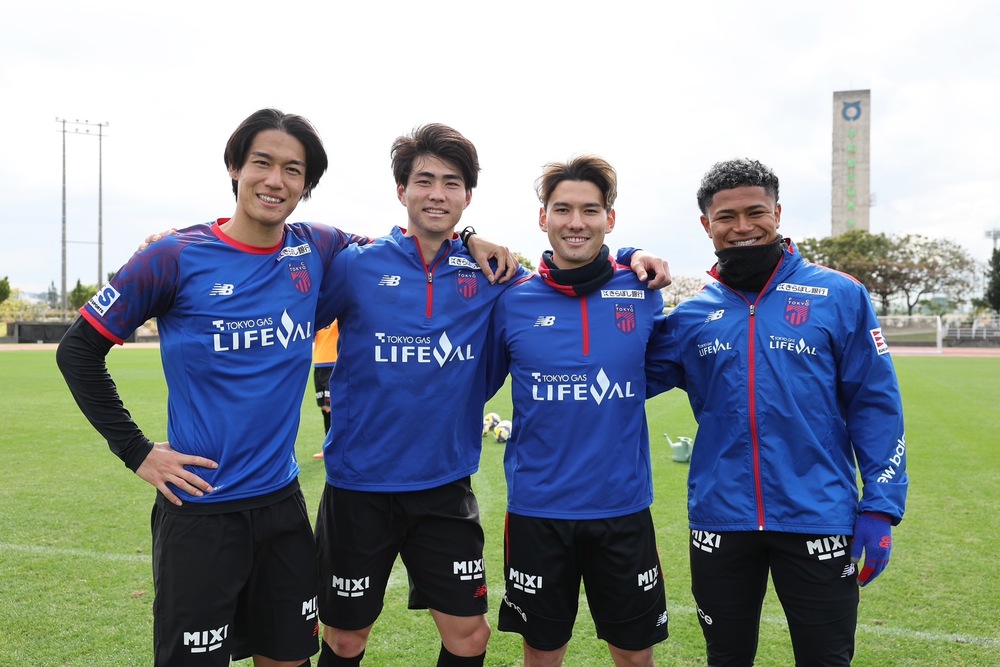
A, I think there are really many players I get along well with. Although my longest relationship is with OKA, I’m also close with my同期 Seiji KIMURA and Kashif BANGNAGANDE, and Taishi Brandon NOZAWA was my teammate on the U-23 Japan national team at the Paris Olympics. There are also seniors and juniors from Meiji University, so I know a lot of people (laughs). Even when I joined, it didn’t feel like I was a new transfer; it’s a very homey and comfortable environment, so I’m grateful for that.
Q: Kizuna Kominato, who has been confirmed to join, has also competed in university soccer.
A, Kominato is also the type to push forward aggressively, so we get along well and talk a lot.
Q: Given that relationship, don't you think you've become too familiar from the very first day of joining?
A: That’s actually one of my strengths (laughs). I have a friendly personality, so I want to bring out my good qualities off the pitch as well and help create a positive atmosphere within the team. I originally planned to join the team training from the very first day and wanted to start as soon as possible, but understandably, I wasn’t allowed to join the full team practice right away (wry smile).
Q: You seemed eager to kick the ball from the first day, didn't you?
A. The camp had already started, so I wanted to join quickly, get into the circle, and build a sense of unity.
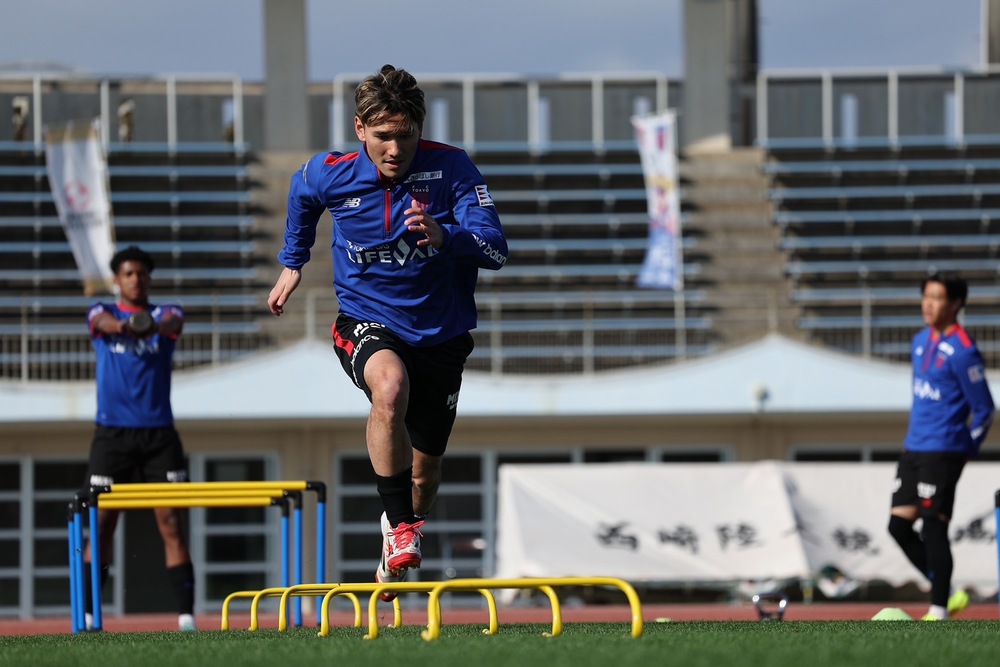
Q: I think you had various experiences during your year and a half living in Germany. How do you reflect on that?
A: My challenge in Germany was playing in a personally tough environment, so I believe there were many difficult periods. I was tested in an environment where players taller than me, physically strong players, and fast players were the norm. I think my physicality and my unique strengths developed through competing against such players. In addition to that, I believe my mindset and skills have also improved, so I want to give back something valuable to this team.
Q: Have you ever faced any obstacles?
A: I have faced obstacles before, but I believe that overcoming them has shaped who I am today. I want to use that hardship as fuel to thrive in Tokyo.
Q: What aspects did you find challenging in Germany?
A: It might be something that every player challenging themselves abroad feels, but the difference in environment was significant. I personally was not able to join the team as an immediate asset, so I always needed to make an effort to prove myself. However, there were also periods when I left the team to participate in activities with the U-23 Japan national team of the Paris Olympics generation, so I didn’t have many opportunities to showcase myself within the team. This might sound like an excuse, but I feel that I was not able to fully demonstrate my abilities. Also, there were many players physically stronger and faster than me, so I couldn’t fully express my individuality. That simply comes down to a lack of ability. On the other hand, there were aspects where I was able to compete in the Bundesliga’s first division, so I don’t think everything was negative. I want to show what I learned in Germany here in Tokyo.
Q: After concluding my challenge in Germany, I have transferred to Tokyo. What are your thoughts on your future career path?
A: Of course, now that I have joined this club, I believe winning the J1 League is the biggest goal both personally and for the club, so I will do everything I can to achieve that. As an attacking player, I aim to score double-digit goals and also provide solid assists. I will give back everything I can for the team and work towards winning the league.
Q: What specific initiatives do you want to implement in Tokyo?
A: I believe it is important not to lower the standards I have felt and to continue pursuing them. There are many players on the team who have competed on the world stage, like Yuto NAGATOMO. I hope to absorb a lot from those players and make it my own strength.
Q: Did you find any common values or ways of thinking with player Nagatomo?
A: I have had opportunities to talk with Yuto-san before and have received advice from him. When I participated in the Japan national team training camp as a training partner, I also listened to him, and since Kento HASHIMOTO was also competing on the world stage, I had communicated with him previously as well. Now that we have become teammates, I want to have deeper conversations going forward.
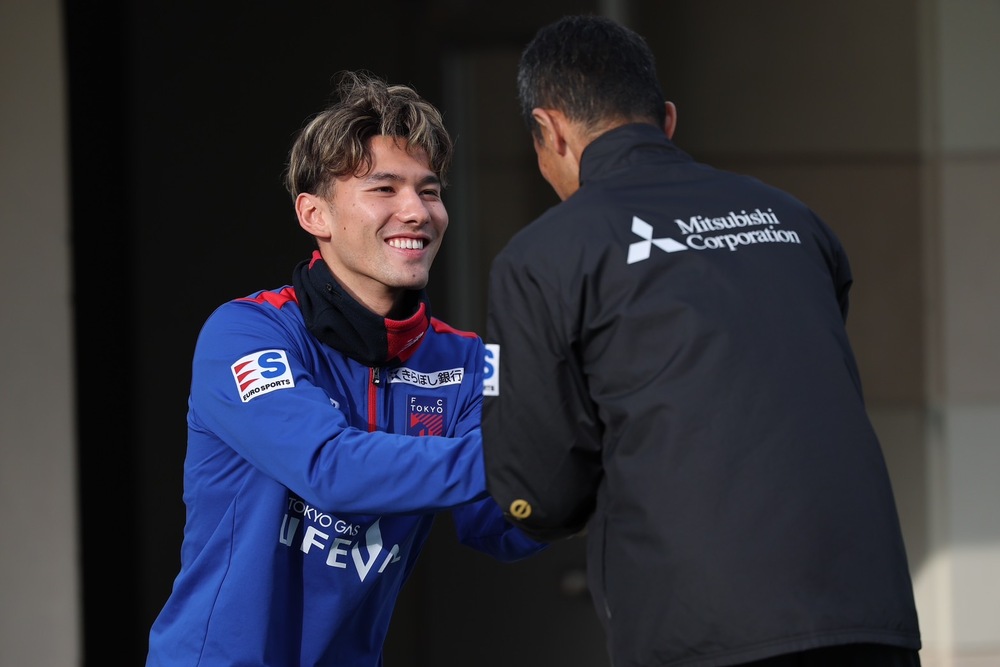
Q: How do you feel about Coach Rikizo MATSUHASHI's soccer?
A: I think he is a coach who thoroughly analyzes the players and builds the team based on that. Although I have only recently joined the training, I find the team style easy to envision even when watching practice from outside. I want to combine my own playing style with that to create something good. The coach also communicates with the players, so I think it’s easy to share the vision.
Q: Just like with the Paris Olympic generation representative team, you give the impression of being a player who becomes unstoppable once you start to perform well.
A: I believe those are also the expectations placed on me, so I want to live up to them. Of course, I don’t want to become too tense; I want to play in my own style. Once I score one goal, I think I’ll really take off.
Q: Please tell us the reason you chose the number 16.
A: There is no deep meaning behind it, but among the numbers offered to me, the one I have worn before was number 16. It was the number I had when I first started as a regular and scored a goal in my second year of university, so I have an attachment to it. Inspired by this jersey number, I want to score 16 goals in the league.
Q: You were already shaking the goal net during training.
A: In the end, there is no victory without scoring goals, so I want to be conscious of that even during practice. First, I want to demonstrate it in terms of scoring.
Q: The Meiji Yasuda J1 League, which I will be challenging for the first time, will finally kick off in two weeks.
A: I want to firmly win the competition and start as a regular from the opening match. I aim to be the team's top scorer and fight with the goal of winning the league for the first time. I myself am really excited about this challenge.
Text by Kohei Baba (Freelance Writer)