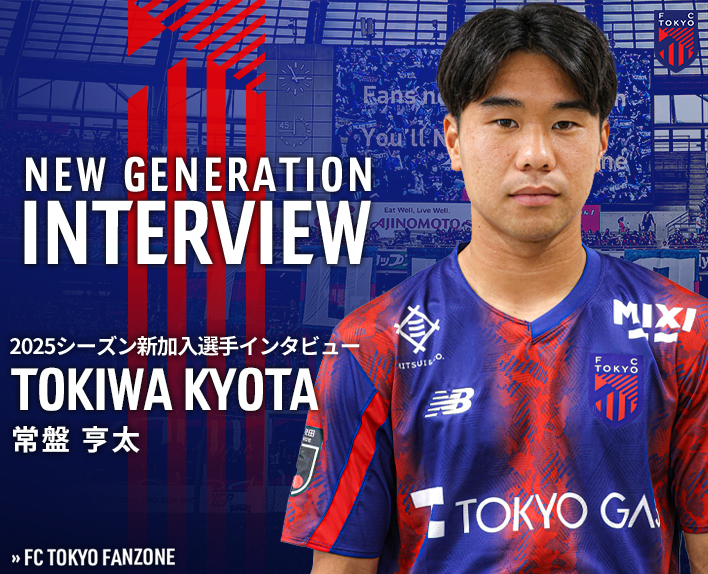


From the academy, via Meiji University, to the top team──. Another passionate man with blue and red blood has returned to Tokyo. Kouta Tokiwai, who missed the chance to be promoted to the top team during his time at FC Tokyo U-18, has grown significantly both as a player and as a person in university. He has evolved from an anchor-type player to one who fiercely battles from box to box, working on his own updates while being conscious of his senior, Shuto ABE, who has followed the same path. What is his determination to challenge the professional world with a strong "love for Tokyo" in his heart?
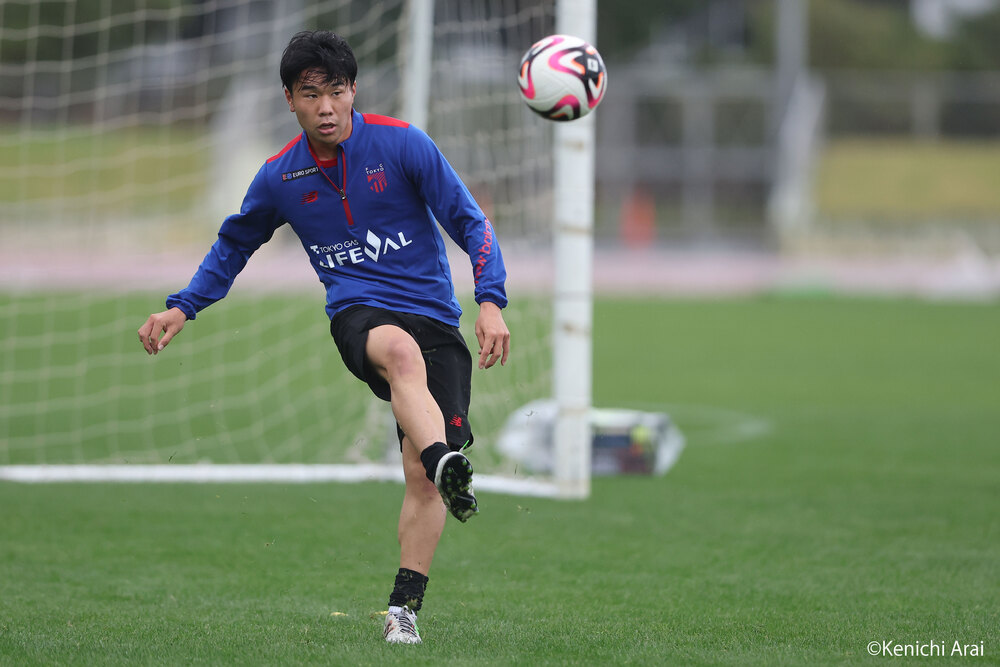
──First of all, welcome back.
Thank you very much.
──I joined after FC Tokyo U-18 and Meiji University. What changes do you think you have undergone in these four years?
First of all, I believe I have changed significantly in terms of personal growth before even considering soccer. Until then, I was very particular and had a strong idea of how I wanted to play, especially up until high school. However, that kind of individual play was not enough to reach the professional level. After entering Meiji University, I started listening more to those around me and balancing my own convictions with flexibility. Coach Daisuke Kurita (Meiji University Athletic Association Soccer Club) taught me to not overthink things in any situation and to learn from the good qualities of others. Until then, I had built walls for myself thinking, "This is impossible for me." Instead of sticking to those assumptions, I began to break down those walls and reconsider. I believe growing to have the mindset of "It's not impossible" is also part of my development.
What areas have you grown in your play?
The part where I feel I have grown the most is that my range has greatly expanded. This applies both to the area I move in and the area I observe. I entered thinking that my strengths were my work rate, ball challenges, and quick transitions, but Coach Kurita constantly guided me on the areas where the range to demonstrate those strengths was limited, such as in the box-to-box role. I have been very conscious of expanding the range in which I move around, both in attack and defense.
──The trigger for such changes was largely missing out on promotion to the top team.
That's right. When I couldn't get promoted, I realized I had been telling myself, "I'm not that kind of player, so this kind of play is impossible." After failing to get promoted, I came to think that I needed to be able to play in various ways and also bring out more of my own strengths.
Have you felt that there are parts of yourself that have changed and are effective while participating in the top team's camp before the opening or during practice in Kodaira?
When I was in my second year of high school, I played in the J3 League with FC Tokyo U-23, but at that time I was overwhelmed and couldn’t fully showcase my strengths. Through participating in camps and training, I gained confidence that not only Meiji University’s “three basic principles” (work rate, ball challenges, transitions) apply, but also that my offensive driving force is effective.
──The midfield in Tokyo is a highly competitive position. Have you considered other options?
From the time I was a first-year student and not playing in matches, Kazunori YOSHIMOTO, the scout in charge, came to see me, and I had absolutely no other thoughts. I believed that competing in Tokyo, in a high-level environment, and playing in matches there is what gives value as a soccer player, so I had no other options.
──As a professional, how do you want to shape your career from here?
I believe that as a university graduate, I am no longer young, and I consider that I was brought in as an immediate asset. The current team has a very deep pool of defensive midfielders, and I think there are many high-level players. However, without being intimidated by that, I want to showcase my strengths and aim to be in the starting lineup from the opening match. I also want to become a player who can lead Tokyo to the league championship as a central figure of the team. Originally, I am a defensive player, and I believe I am good at duels, anticipation, recovering second balls, and taking the ball away from opposing players. People who know me from my academy days probably have the image of me as an anchor-type player, but I want to be a box-to-box player who moves vigorously and contributes both defensively and offensively. I think that winning the ball defensively is also the start of an attack, so when I win it, it means I have taken a player out of the game. I want to maintain strong defensive intensity while also having offensive drive. I want to be a player who can decide matches with defense and also score goals to seal the game. It might be a bit ambitious, though.
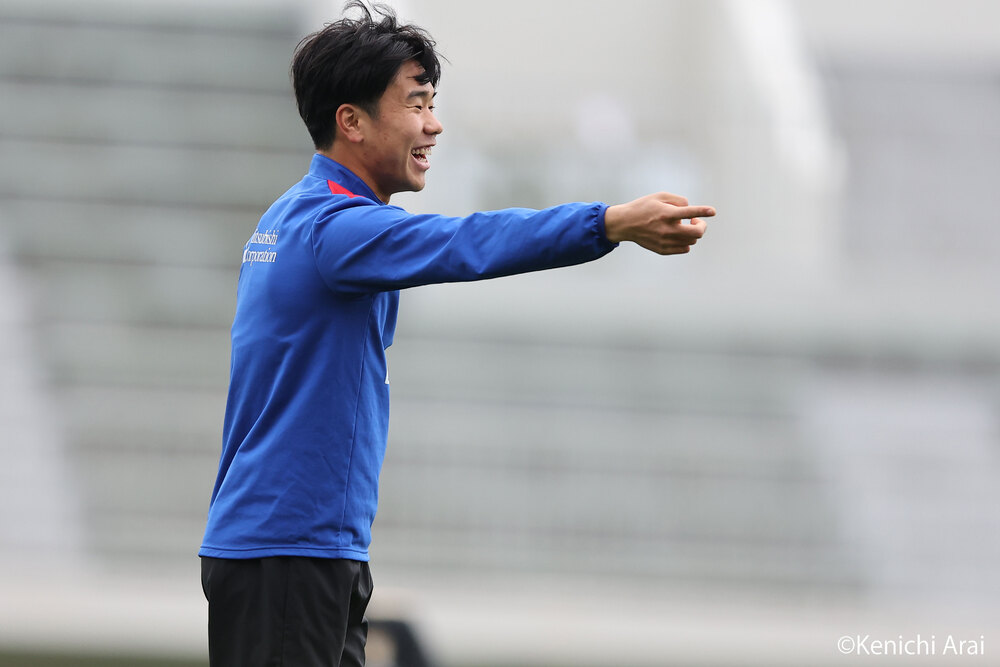
──Indeed, during my time at FC Tokyo U-18, I was a player who led the team with my voice and scored in crucial moments. I also have the desire to show the fans and supporters who have supported me since my academy days that kind of play again.
At Regista FC during my elementary school days, I was always told to focus on competing and never to lose. Of course, there was a part of me that wanted to enjoy playing soccer, but once I was on the field, I was always instilled with the mindset of never losing to the opponent in front of me, absolutely scoring here, and being aware of those crucial moments. I think that mindset matched well with FC Tokyo U-15 Fukagawa and FC Tokyo U-18. I believe I do have a certain competitive strength or instinct for competition. I think I was able to show that side of myself since my academy days, and I want to prove that I can do the same in the professional world.
──I think that my playing style is similar to that of my senior Shuto ABE, who followed the same path from the academy to Meiji University (currently at RWD Molenbeek). Do you want to succeed in Tokyo and make your way to the world like him?
Yes, when I entered Meiji University, Coach Kurita constantly made me aware by saying things like, "If it were Abe, he would have done this," or "If it were Abe, he would have done that." There were even times when I was told, "Abe would have done it this way, but your play is still small." I have been compared to him all along, so I am definitely conscious of it. However, I am myself, so while bringing out my own strengths, I want to become a player who can represent Tokyo and go global like senior Abe.
Does having players you played with during your academy days make it easier?
Yes, even when I went to camp, there were many players I had met during my academy days, so I quickly felt comfortable and it was easy to communicate. Taishi Brandon NOZAWA and I shared a two-person dorm room during our time at FC Tokyo U-18. He was always attending the top team's training, while I would come back from school and go to FC Tokyo U-18 practice. He was always ahead of me, so I absolutely want to catch up and surpass him. He is a very important and significant presence for me, and I am very conscious of that.
──Did you have any thoughts when Nozawa was selected for the Japan national team for the AFC Asian Cup 2023?
I immediately contacted him to say "Congratulations." However, in my heart, I was thinking, "I will definitely not lose."
──Soma ANZAI, who was playing together at FC Tokyo U-15 Fukagawa, has also made his debut ahead of the others. How did you see that?
I moved up my entry into the professional world by a year from university, but I wasn’t in a hurry about it. I truly feel like a member of the team, and I think my playing time is quite high within the team, so it’s really motivating. The same goes for Taishi, and having many players ahead of me who are performing so well is very inspiring and fuels my fighting spirit to definitely succeed as well.
I understand that players from the academy via university are struggling in the top team, and I also had considerable determination to jump into an environment where I don't know what my chances of playing will be.
I have seen Shuto OKANIWA and Tsubasa TERAYAMA go on loan transfers or not even make the bench, and I think that possibility might also come to me. However, what to do when I can’t play is something I learned at Meiji University. There is also the option to play in categories like the J2 League or J3 League, but entering the professional world at the age of 22 means I don’t think my playing career will be very long. I have the ambition to challenge myself in the J1 League from the start and absolutely win my place in the end. With determination, I always think that I will definitely succeed.
──A player whom we hope will wear the captain's armband has returned to the blue and red. There must be high expectations for an academy graduate to shine amidst the changing team.
Having been raised at FC Tokyo U-15 Fukagawa and then joining FC Tokyo U-18, I believe I possess a greater sense of love for Tokyo and the blue-red spirit than many other players. This season, the team may be seen as struggling since we haven’t achieved results in the league matches. However, I believe Tokyo definitely has the environment, players, and staff capable of reaching the top. I want to make my presence felt as someone who can take a central role in aiming for that pinnacle.
──Kumatoriya Issei and Uchida Yosuke, who were classmates at Meiji University, will wear green uniforms. If we end up facing each other, it will probably be a more intense match than usual.
They are both very close friends, so I said, "Are you really going?" (laughs). Since I joined Fukagawa, I have believed that I should not wear anything green. Takashi HARA and Masato OTA also told me the same. So even now, I do not wear anything green. I always have that mindset, so I absolutely cannot imagine losing. I definitely want to win.
──I am looking forward to reuniting with Mr. Okuhara and the people who took care of me during my academy days in the top team.
Even when I participated in camps and training sessions, I was told, "Not there yet." When I joined training around summer, I was also told, "I'll test how much better you've gotten at stopping and kicking." Mr. Okuhara skillfully guides me to bring out my motivation. I believe there are expectations involved, so I want to meet those expectations and become an even greater presence.
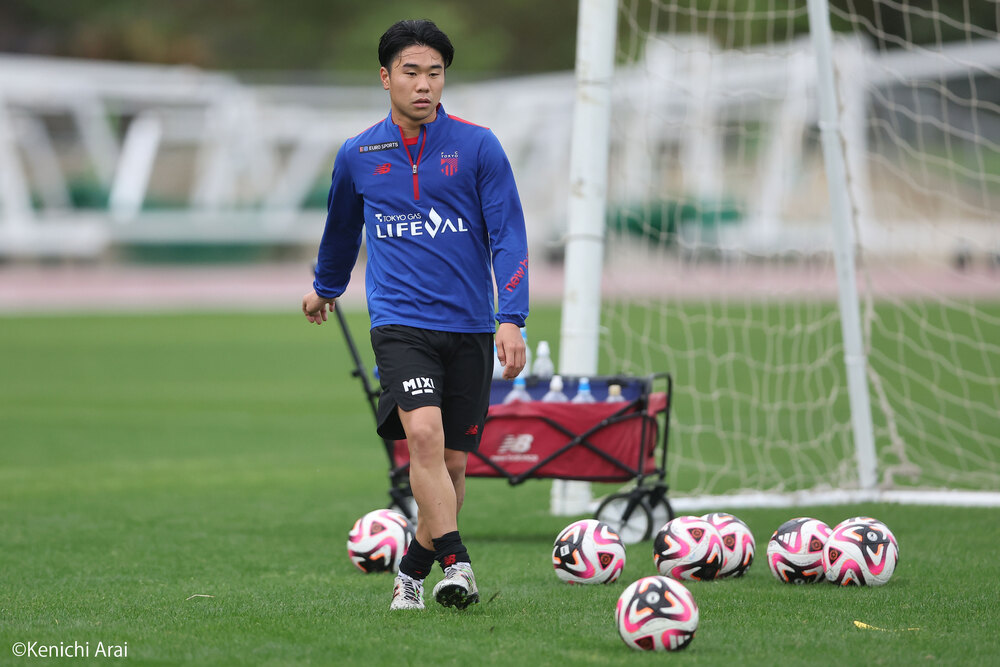
──When I talk to the academy staff, I really feel a sense of attachment and expectation. How do you want to respond to the expectations from the coaches involved?
Because I require a lot of attention, maybe that's why I've been noticed in that way. I really did whatever I wanted in the academy. When it was decided that I couldn't move up to the top team, there were times I thought, "Then I’m not going anymore." But if I hadn’t joined Fukagawa, I wouldn’t be who I am now, and if I hadn’t had my U-18 days, I don’t think I would have become a professional, so I want to express my gratitude for that. Also, given my height and the fact that my physical abilities aren’t high, I believe that a player like me being able to join and succeed in Tokyo’s top team can be a source of hope not only for the academy staff but also for the players currently in the academy. To become that kind of player, I want to work hard from here on and become a representative player of the academy.
──Finally, could you say a word to the fans and supporters?
It has been the same since my time at FC Tokyo U-15 Fukagawa, but I believe there is no other team that supports its academy players as much as FC Tokyo does. That is also one of the factors that greatly strengthened my love for Tokyo. I truly appreciate the expectations of those who have supported me, and I am determined to become a player who is supported even more. I hope everyone will look forward to the progress I will make over the four years at university.
♢Kyota Tokiwa Profile
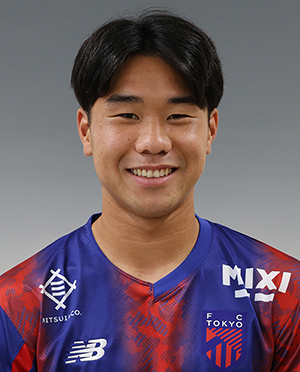
Date of Birth: April 9, 2002
Height/Weight: 173cm/70kg
Hometown: Katsushika, Tokyo
Career: FC Tokyo U-15 Fukagawa → FC Tokyo U-18 → Meiji University
Text by Kohei Baba (Freelance Writer)