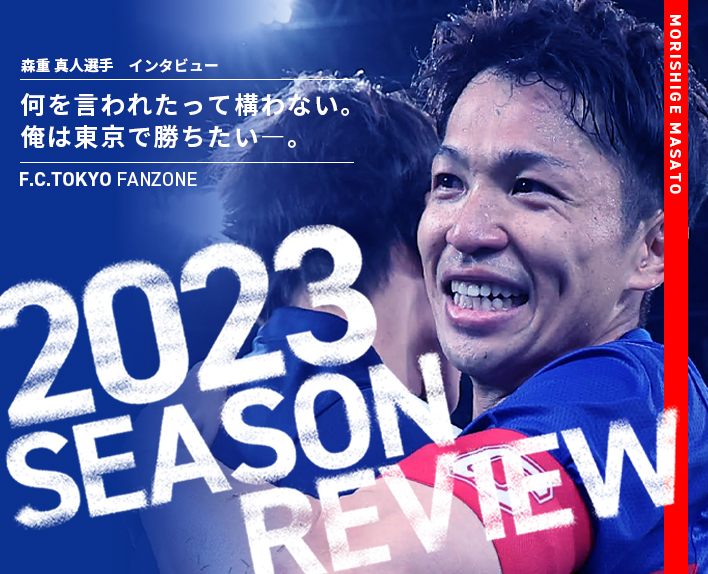


Masato MORISHIGE, who finished his 14th season in Tokyo with a top 10 ranking for the first time in 6 seasons, concluded, "I only feel a sense of crisis." Having spent half of his life as a professional football player, he can see the end of his career approaching. The longest-serving player on the team even says, "I don't care what people say or think." In his summary of the 2023 season as captain of the blue and red team, his words were filled with a desperate cry. Within them, a strong determination to win was evident.
It was unclear what we were aiming for and what kind of football we wanted to play.
Q: First, please share your honest thoughts looking back on this season.
A: It was a tough season. That is my honest impression at this moment.
Q. I think you had a good time during the pre-season camp, but after that, the matches became gradually unstable. What was your impression of the start?
A: Including the camp, we had a good sense of confidence. The overall atmosphere of the team was positive, and with Albert PUIG ORTONEDA entering his second season as head coach, we approached the opening match with the mindset of "Alright, this is the season." We were able to secure a victory against the Urawa Reds there, but we dropped points in the following matches against Kashiwa Reysol and Kyoto Sanga F.C. I thought we would gain momentum after beating Urawa, but I believe we stumbled a bit. A strong start is crucial, and not being able to secure wins then was significant. Our record of 1 win, 1 loss, and 1 draw in the first three matches reflected our true ability and the reality of this season.
Q, After that, entering Golden Week, we continued to suffer consecutive losses and faced Kawasaki Frontale in the Tamagawa Clasico at the Japan National Stadium.
A, Winning the match against Kawasaki was, in a way, a result typical of Tokyo. It was like a festival—when everyone's motivation is high, we can win. In special games like the opening match or those held at the National Stadium, we unite our feelings and achieve results. Winning against Kawasaki there certainly boosted our confidence. However, looking deeper, the reason for the victory was not that our football had been refined and reached a high level of completion. Rather than a sense of accomplishment, it was the strength of our feelings in that moment—driven by a sense of crisis and motivation—that led to the win. It did not feel like we earned points because our football had matured.
Q, Unable to use the victory in the Tamagawa Clasico as a turning point, the team went on to record 1 draw and 3 losses before the coach was replaced. What were your thoughts during that time, Morishige?
A. The aspect of connecting passes, which we had worked on for a season and a half, gradually became risk-averse, and we ended up making only safe decisions. For example, simply connecting passes around the perimeter made it easier for the opponents to defend. Without any breakthrough strategies from there, we inevitably relied too much on individual efforts. Although ideas such as using the center or sometimes simply kicking the ball were emerging, things gradually became disjointed, and ultimately, there was no unified understanding within the team about what we should do, resulting in poor outcomes. I think it was unclear what we were aiming for and what kind of football we wanted to play.
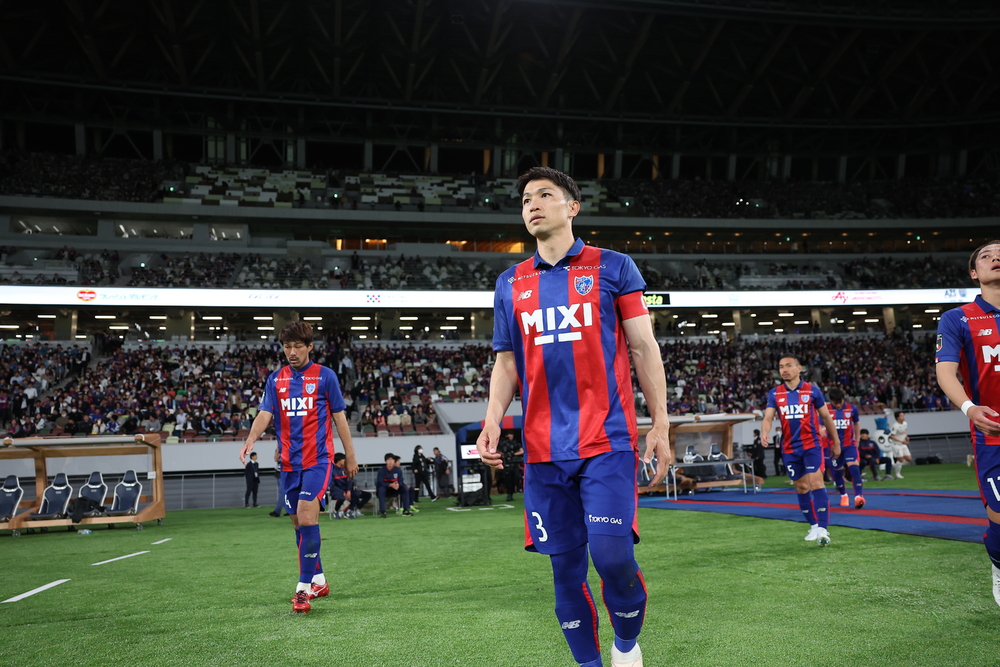
Quality and ideas to score goals are needed
Q, In the early stages of the second half of the season under Coach Peter CKLAMOVSKI, there were signs of gradual upward growth. During that time, what was going well, and where did you feel uncertainty?
A, After the coaching change was decided, Head Coach Takayoshi AMMA clearly reaffirmed what needed to be done in the first match. I believe we were able to thoroughly review the fundamental aspects of our soccer that we had not been able to execute properly. Thanks to that, we were able to win against Kyoto in the Levain Cup group stage. From there, with Coach Peter CKLAMOVSKI taking over, we adopted an attacking style of soccer and continued to engage in high-intensity training. While seeking to utilize that intensity in our play, it was important to first accumulate points. In the early stages of the second half of the season, we aimed for soccer that could reliably win rather than an ideal style, working more faithfully to the basics and valuing the essence of the game.
Q. The team seemed to be on the rise as it accumulated points, but from Sec. 24 against Yokohama F.Marinos, there was a stretch of four winless matches. What do you feel were the reasons for not being able to clinch close games against the top teams?
A, One reason might be that there was no breakthrough strategy. Until then, we were able to overwhelm opponents with a high line, high press, and intense play, but against opponents at a higher level or those who defend by sitting back, we needed one or two different ideas and attacking approaches from different angles. We lacked those options, and I believe that difference affected our loss of points.
Q, I think that has also been an issue we have been facing since the 2022 season.
A, in the second half of the season, we focused on overwhelming the opponent through intensity and quick transitions between offense and defense. Even though we aimed to play offensively, the impression was that we still had very few attacking methods and patterns. While we advocate for attacking soccer, I believe we ourselves are currently struggling to improve. From here, players with the quality and ideas to score goals need to emerge even more.
Q, This season, Diego OLIVEIRA has regained form and scored 15 goals. However, there was a significant gap in the number of goals compared to the next highest-scoring player.
A, I think we are gradually establishing a shared understanding of which areas the team aims to take control of and where to send the ball when the opponent approaches in a certain way. After that, it’s about how to increase the reproducibility of these actions and create more opportunities. We need to work harder on this, but ideas are absolutely essential for the attack. I hope that players who possess such ideas and can lead the attack will emerge.
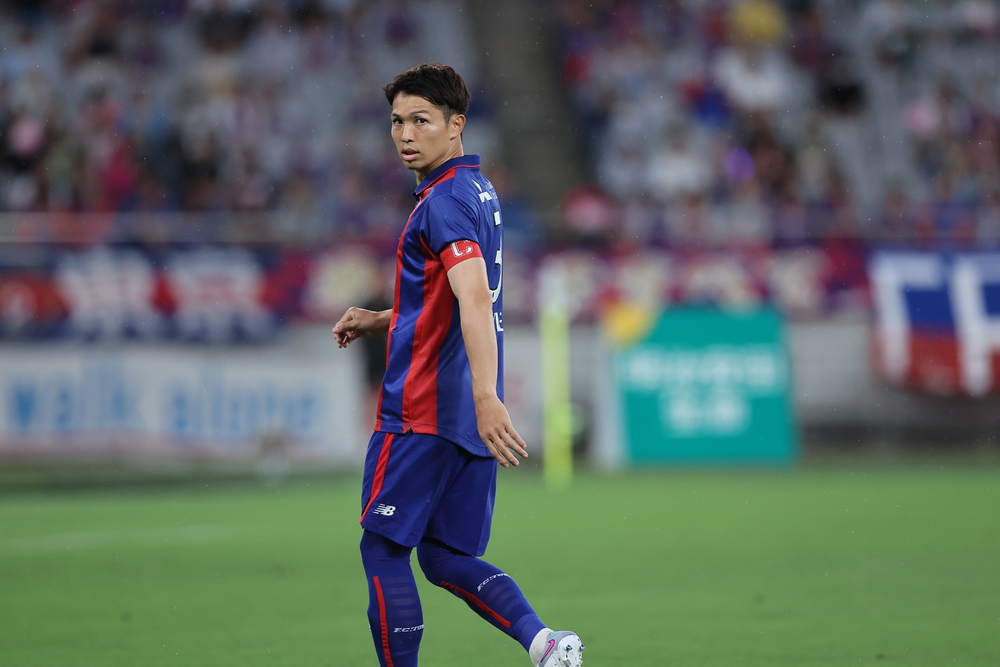
It's just right for young players to be noisy.
Q, For that, I believe the maturity of the team is indispensable. I think the team cannot make use of ideas unless there is conviction, not just improvisation or mere whims.
A, there may be some aspects that the players themselves need to think about a little more. Overall, there are players who tend to be too passive and have their own opinions on how things should be done. It is important for each player to share their thoughts and opinions from their respective positions and work together to create something good. Yuto NAGATOMO and I, who are in the final line, are communicating what we see from the back. However, there is an impression that the communication ends with a one-way conversation of "Oh, I see, I have to do that.".
Q, Is this the part of the problem that Tokyo has been facing?
A, that’s not the case. For example, there might be a situation where something looks a certain way from the back. However, while the defensive side says that, the attacking side or midfield might think that’s impossible or have a different opinion. If they don’t communicate that, they can never truly reconcile their views. Since we play as a team, communication is absolutely essential. Each player surely has many things they believe are absolutely necessary for them to shine and perform better. Instead of keeping those thoughts silent, by exchanging opinions with each other, new discoveries are made and understanding deepens.
If you only do what you are told in silence, you will not become a team. You have to speak up. Of course, each player has their own character. Even without saying it, players who can execute will demand it from the beginning, like Kuryu MATSUKI. They are naturally able to move those around them in a way that is easy for them to do. If you are not afraid of being misunderstood, or avoiding conflicting opinions, the conversation will not move forward. From there, the next step of aligning and unifying our intentions will begin.
Q, During the season, you were often seen telling the mid-level and younger players to speak up more and giving them advice.
A, it’s just right for the young players to be loud. Unless they lead the team, the team won’t have any energy. I think it’s strange that we keep playing in matches forever. For better or worse, Tokyo has many serious players. There have never been any sharp players since long ago, and I think they might be too quiet.
Q, Just as Morishige, who used to play quietly when he was young, has come to think and exchange ideas, even if it takes time, if players who speak up do not emerge, continuous strength in the future cannot be achieved, right?
A, For example, Nagatomo is someone to be respected. However, respect and being overly cautious to the point of holding back during a match are different. To improve, you have to make demands. If as a result things get worse and you can’t play well, soccer isn’t fun. If you are someone who actively demands from those around you in the way you want and leads the attack, there is absolutely no problem. Without that, if everything is just reactionary, nothing will come of it. Balancing things is our job, so young players are free to do as they please. It’s okay to cause trouble for the team, play as you think best, keep challenging yourself, make mistakes, and unless you’re pushing yourself to the point of overdoing it, I actually feel it’s difficult otherwise.
Q. Both Morishige and Nagatomo gave the impression that when they were young, they played on the pitch as they pleased. I remember the veterans having to clean up after them with a wry smile, even if it meant arguing with their seniors.
A, That’s exactly why I can’t understand it. Playing without saying anything isn’t fun, right? In the current situation, you must be thinking, “It would be better if I did this,” or “I wish someone would pass me the ball.” You definitely think that. You have to demand things like, “Why aren’t you facing forward?” or “Face forward and pass it here.” Of course, if everyone does whatever they want, we can’t win, but for example, if Matsuki starts doing that, others will resonate and respond, creating an atmosphere where if you want to play this kind of game, we’ll support you more. By demanding each thing one by one, good soccer is built.
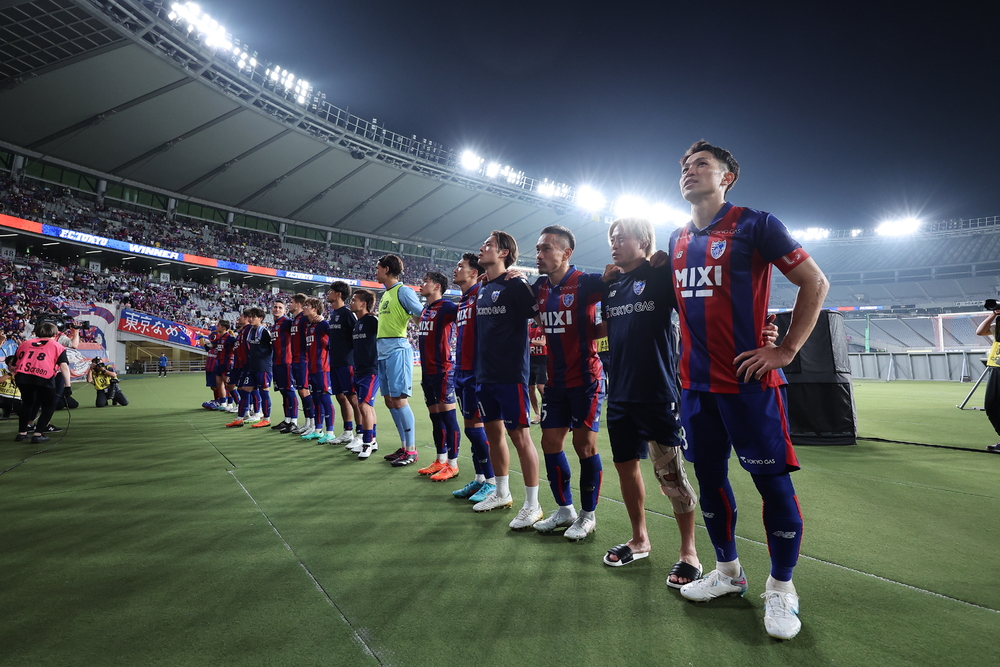
I want to win in Tokyo
Q: Unfortunately, Morishige's own streak of consecutive goals ended this season, but you were able to finish with a win in the final match against Shonan Bellmare.
A: I don’t care about the records at all, and it’s not like I’m going to receive anything for them (laughs). We were able to finish with a win in the end, but we need to calmly reflect on this season and analyze it thoroughly. Looking ahead to next season, I only feel a sense of urgency. To be honest, I don’t feel much accomplishment from this season’s end. At this rate, I can’t imagine a bright future waiting for us. Every season is a battle, and I know that if just one gear meshes properly, the team can do well. I want to keep struggling while maintaining this sense of urgency.
Q. How should this team change for the next season?
A. It is important for the mid-level players to take the lead in driving the team forward. Within that, since we have adopted an attacking style as our playstyle, everyone must contribute ideas in the finer details and situations to build it up together. Having decided to pursue victory with determination regardless of the outcome in that style, we have no choice but to carry it out.
Q: Since you spoke harsh words at the final home game, I think you will also face strict scrutiny yourself.
A: I said that with full determination, and I put it into words also to put pressure on myself. Right now, the team needs to have a stronger sense of urgency. Each player must take responsibility and step onto the pitch thinking of themselves as a core player of Tokyo. I don’t mind what is said about me. I am waiting for as many young players as possible to resonate with this. If anyone wants to criticize someone, they can criticize me for saying, "I want you to play the way you believe." That’s why I want the young players to become the core of the team without any fear.
I want to win with Tokyo.
Text by Tadashi BABA (Freelance Writer)