

<Match Preview>
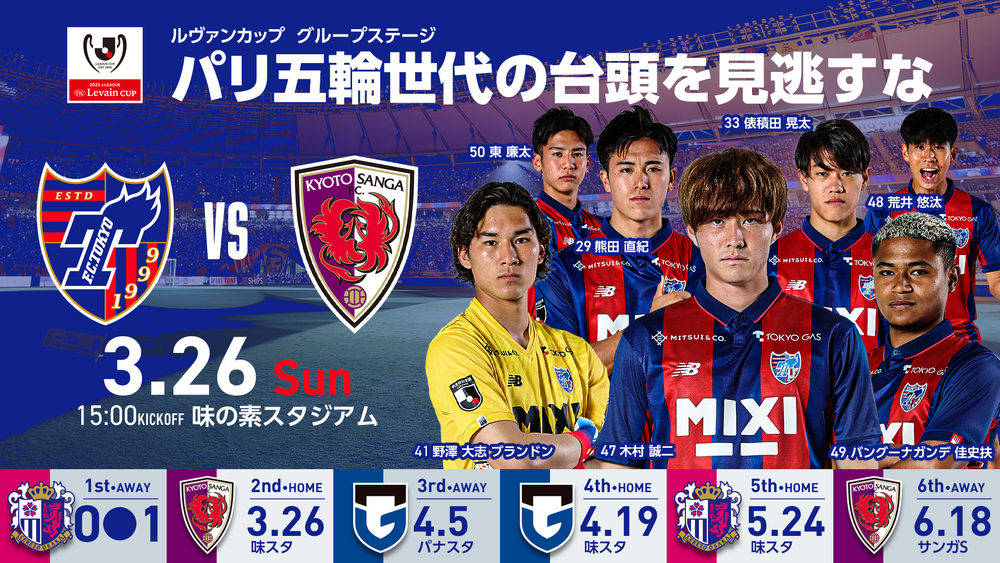
In the first match of the Levain Cup group stage, Cerezo Osaka suffered a 0-1 defeat. Despite the loss, many young players, including Ryunosuke SATO from FC Tokyo U-18, had the opportunity to play. 16-year-old Ryunosuke SATO reflected positively after the game, saying, "The 60 minutes I played were the most intense time of my life. I want to build on this for the next game."
The second match will welcome Kyoto Sanga F.C. to the home ground. The team, led by coach CHO Kwi Jae, plays a style of soccer that emphasizes high pressing and strength in ball battles. In addition, the height of players such as Kosuke KINOSHITA and PATRIC adds to their strength. In the league match, they defeated Tokyo in the third round and went on to win three consecutive games. For Tokyo, this will be a chance to take revenge.
Kuryu MATSUKI and Naoki KUMATA, who participated in the U-20 Asia Cup as members of the U-20 Japan national team, have returned to the team. Expectations are high for KUMATA, who became the top scorer of the U-20 Asia Cup with 5 goals, to make his first official appearance as a professional player. As MATSUKI says, "If we can lead the young players, the team will become stronger," the success of the young players will surely contribute to the improvement of the team. In order to gain momentum for the consecutive matches starting in April, the players will go for victory with their dynamic soccer.
Matchday Program here
[Albert PUIG ORTONEDA Interview]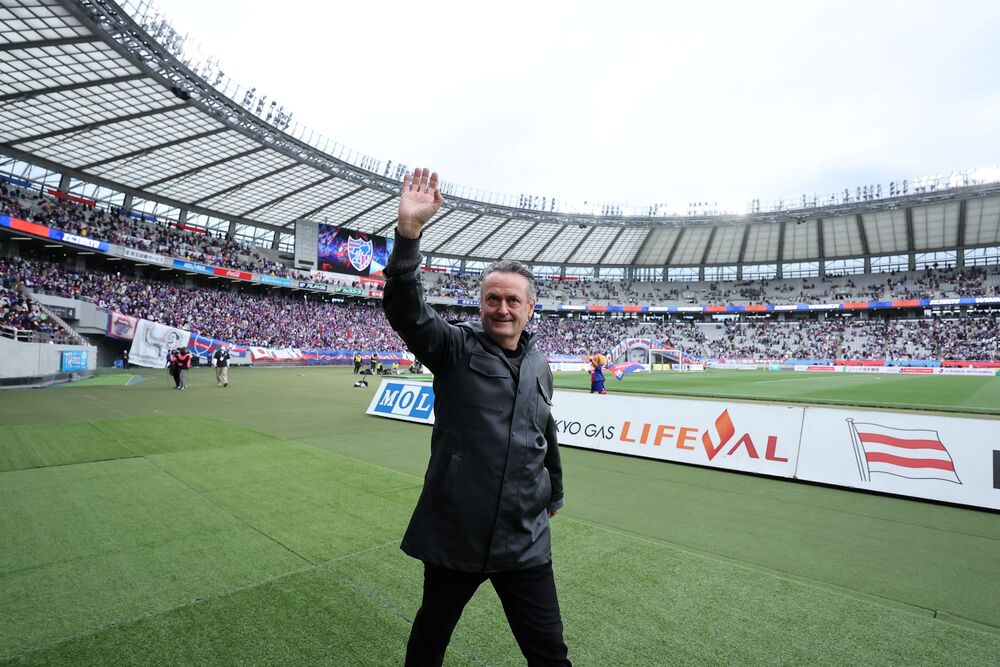
Q: There is one week until the next league match, and I think there is plenty of time. Who will you welcome with tomorrow?
A: I think it will include not only players who have had few opportunities to play but also several players who have participated in league matches. I want to give some of them a rest. As for the other players, since they have had a week to prepare, I think some of them will play. I want to continue giving young players chances, and I intend to keep doing so this time as well. Whether they start or come on as substitutes, I don’t know yet, but I want to give young players opportunities.
Q: Is it your belief that players who have participated in league matches should also be utilized, considering their condition?
A: There are aspects that are like that and others that are not. What we must keep in mind is that there will be a congested schedule continuing in April. This season, there are periods with a congested schedule, but there are also times with very few matches, resulting in an irregular schedule. There are also weeks without matches in the summer. Since April has a congested schedule, we took that into consideration when selecting this week’s members.
Q: What do we need to do to advance to the next round?
A: Regarding the first match against Cerezo Osaka, I don't think the loss was a result of deserving play. At the very least, a draw would have been a fair outcome. In every match, we always aim to win. However, if we only focus on match results, when will we be able to give young players opportunities? To judge how much young players can grow and what they are capable of, it is necessary to let them play in official matches. As I have mentioned before, I hope the Levain Cup will establish rules that require more use of young players, making it a cup competition where young players can truly shine.
Q: It is said that there is no difference between the world and Japan until the age of 18, but is the difference that opens up after those three years due to the difference in experience in official matches?
A: There are various stages of growth. I believe that allowing players to play more freely until the age of 12 is the most important. In that regard, I think Japan is functioning well. It is necessary for the junior youth generation, as referred to in Japan, to spend three years learning tactics at the academy. I also believe Japan is moving in a good direction in that aspect.
The remaining challenge is the youth generation in the pre-professional stage. In order to develop high-level professional players, the youth and college age groups, as they are known in Japan, are crucial. The generation between 19 and 22 years old, I believe, will gain experience and grow through competition. For example, how much did Matsuki improve in the past season? I think he improved a lot. This is because he was able to play official matches and had to focus on winning. If Matsuki had not been given a chance, he would not have grown. On the other hand, in other countries, that generation is gaining experience and growing through high-level official matches. In terms of this aspect, I think there is room for improvement in Japan. Without improving in this area, it will be difficult to aim for even higher levels.
To aim for a higher level, it is important to accumulate difficult game experience in the generation of around 20 years old. Sometimes I think that great players like Mitsumata will come out, but in order for such great players to consistently emerge, fundamental reforms are necessary.
In soccer, it is said that the central player is important. Japan's level is still not high for positions such as goalkeeper, center back, defensive midfielder, and center forward. The reason why Japan's player pool is thin is because, for example, how many young center forwards do professional soccer club coaches want to use? I think there are few coaches who would use an 18-year-old goalkeeper in a league match. The same goes for a 17-year-old center back. It is difficult for any country to make the decision to use young players in central positions. However, in Japan, because young players are not being used in that zone, it becomes a vicious cycle where they do not develop easily.
Q: Is there a possibility that young players who have not had a chance to play so far will play tomorrow?
A: I am thinking of giving opportunities tomorrow. However, opportunities are not something given as a gift; they must be earned. I am not at all worried about using young players. But when it comes to giving chances to any young player, they must prove that they have a high level and be mentally strong and highly motivated to be given a chance. I am fully prepared to support young players to grow going forward. However, whether they can seize the opportunity depends on themselves.
Q: Kashif BANGNAGANDE has been selected for the Japan national team.
A: I continue to expect Kashif BANGNAGANDE to keep growing because the level required as a Japan national team player is very high. I believe Takefusa KUBO, who is his classmate, has reached a wonderful level. My hope is that Kashif BANGNAGANDE, Hotaka NAKAMURA, Kuryu MATSUKI, Takefusa KUBO, Naoki KUMATA, and Kota TAWARATSUMIDA will all be named members of the Japan national team.
[Player Interview]
PEROTTI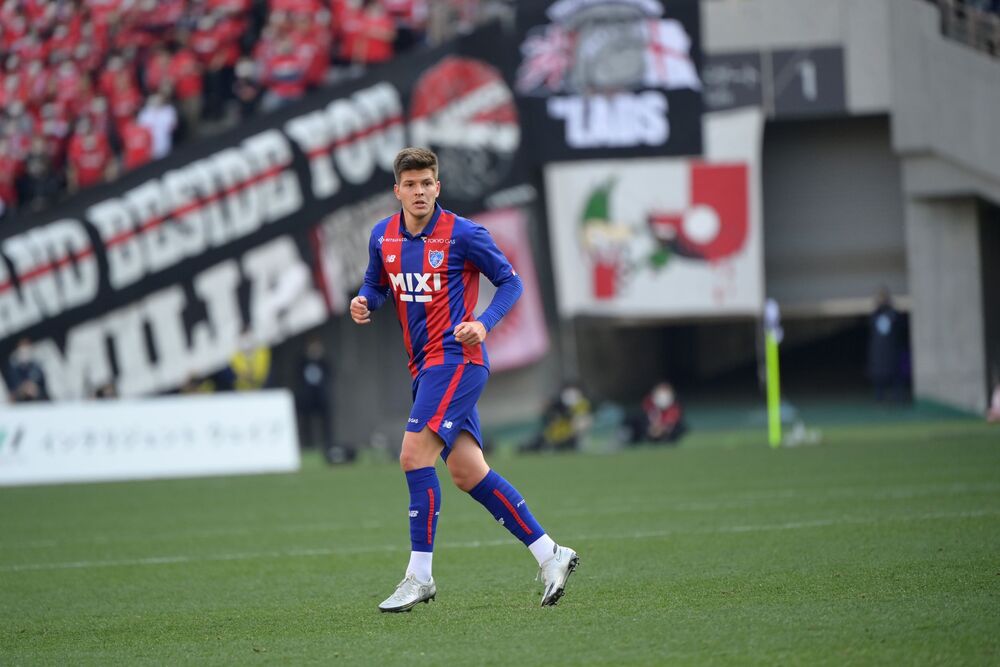
Q: Although there was hardly any playing time in the Nagoya match, did you feel any frustration?
A: I always have the desire to play in matches. However, I understand that the flow of the game and the coach’s strategy also play a role. Rather than feeling frustrated, I think it can’t be helped. The style of soccer in Japan is different from the style I have played so far. I have only recently arrived in Japan and haven’t played much in matches yet. Of course, I need to adapt, so from now on I want to play better and contribute to the team’s victories.
Q: I think you are always included in the substitute members in practice matches and league matches. Is it because you just joined the team and there are no problems yet, or do you think you need to score even in a short amount of time to secure a starting position? What do you think?
A: I prepare to score regardless of how many minutes I play. Whether it’s 5 minutes or 90 minutes, I believe my role is to give my all during the time I am on the field. As a forward, I always have the desire to score every time. However, goals are not easy to come by, and I think they are not something you can get easily. I haven’t scored yet, but depending on the match, I might score two or three goals. I think it depends on the flow of the game.
Q: When you make a good shot during practice, the fans also get excited, but how do you feel about your own performance and condition?
A: I always think that what I practice will lead to goals and results in matches. I want to train well and prepare for the games. Of course, after finishing today's practice, I plan to train even better tomorrow than today. I have the desire to score goals, but even if goals don't come, I hope to contribute to the team in other ways.
Q: I often see you interacting not only with Brazilian players but also with Japanese players. I can feel your attitude of trying to blend into the team.
A: I hardly understand Japanese, but since coming to Japan, my teammates and staff have warmly and kindly accepted me. I am truly grateful for that. Even on the pitch, everyone comes over and shows concern for me. Since my time at Chapecoense, I have had the desire to help others and a feeling of respect for people. I have always communicated with various people.
Q: Do you have any enjoyment you found after coming to Japan?
A: I have always had the hope of playing in Japan. Within that, I was able to achieve my dream and goal. I thought there would be difficulties after coming to Japan, but the people here, including the city itself, are truly wonderful—beyond what I had imagined. My wife is also enjoying life in Tokyo. I want to start from here and achieve my goals.
Q: Why did you want to come to Japan?
A: In 2017, I had contact with players who had played in Japan. Those players said that Japan is a very good country, including its culture, customs, and soccer. I also had a strong desire to go to such a country.
Q: What surprised you in Japan?
A: There are two things. First, I think the small children in Japan, around elementary school age, are very cute. Also, I was really surprised to see those elementary school kids, about seven years old, going to school alone without their parents. The second is the Shibuya Scramble Crossing. There aren’t that many people in my city. I was amazed by how many people were there.
Q: Which city in Brazil is close to Tokyo?
A, if we talk about a large metropolis, it would be São Paulo. However, it is not comparable to Tokyo at all.
<Taishi Brandon NOZAWA>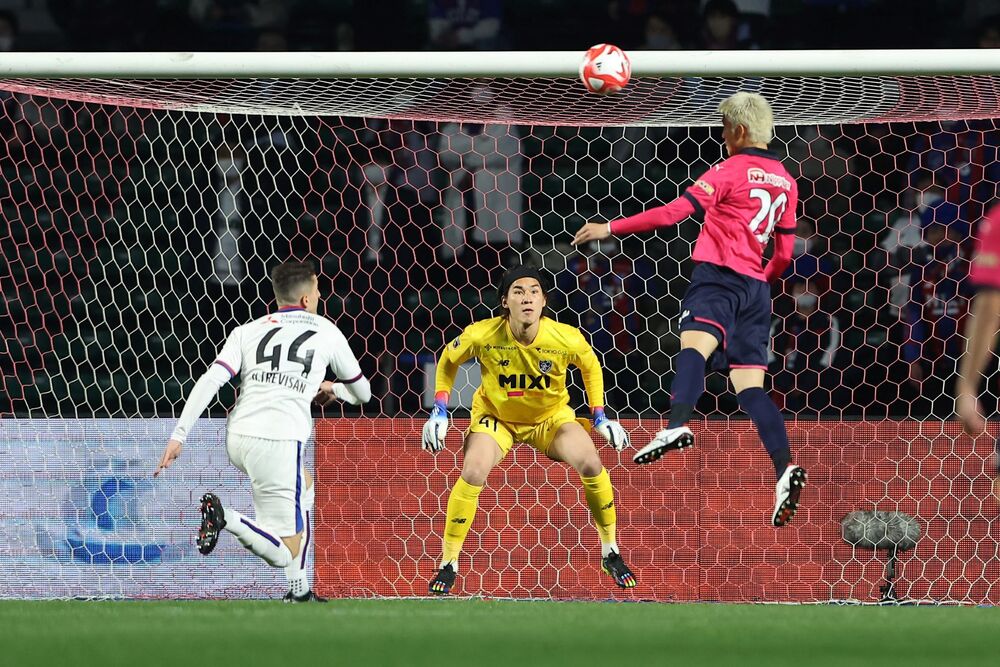
Q: You experienced a year and a half on loan at Iwate Grulla Morioka from the middle of the 2021 season. You have returned to Tokyo this season, so please tell us about your feelings up until now.
A: The league matches have started, and one Levain Cup match has also been played. Last season, I watched Tokyo as a player from another team. Now, I am personally very happy and excited to be fighting as a member of Tokyo. Of course, I am not playing in the matches yet, but as a team, we are committed to winning every game and are able to train daily with that focus. I believe I am spending very fulfilling days.
Q: What changes do you feel in Tokyo now compared to before you transferred?
A: Before transferring, Kenta HASEGAWA was the manager. Since last season, Albert PUIG ORTONEDA has taken over as manager, and I think there has been a significant change. What we are working on now is a style I have never experienced before. At Iwate, I played in a style different from the football Tokyo is aiming for now. Returning to Tokyo, the goalkeeper is also actively involved in the attack, and during defense, it’s about how to maintain concentration and prevent the few critical chances. There are many elements I have never experienced before. Adapting is a tough task, but I find it rewarding.
Q: Are you good at playing a play style that requires technical skills at the goalkeeper's feet?
A: I'm not particularly good at it, but that doesn't mean I lack confidence. After all, the most important thing as a goalkeeper is to protect the goal. Since that responsibility is the most demanded, it is something the coach and I align on, but the most important factor is to avoid taking risks and eliminate mistakes. I don't think it necessarily requires being extremely skilled with my feet to fulfill that. I believe there is no problem as long as I can do the very basics properly and naturally.
Q: Please reflect on your experience of continuously standing on the pitch as the main goalkeeper for Iwate Grulla Morioka and also experiencing promotion from J3 to J2 over the course of one and a half years.
A, I think I have learned the responsibility of playing in matches. Of course, there are several goalkeepers in the team, and only one can play in the match. There are also sponsors, team staff, fans and supporters, and people in the local community who support Iwate Grulla Morioka. I have been thinking about playing in the matches as a representative for those who support and cheer for us.
Although I was allowed to participate in the game, I was made to realize that my behavior was not suitable for a player on the field. Therefore, I learned the responsibility of needing to do more, have more confidence, and have the courage to stand on the pitch in order to win for the team. That was the biggest thing for me.
After returning to Tokyo, I still need to grow technically, but at the same time, I have gained confidence by learning about responsibility. When I stand on the pitch now, I feel much more relaxed than before I transferred to Iwate, and I think I have become better at making calm decisions. In that sense, I am truly grateful for the year and a half I spent in Iwate.
Q: This season, I started in the Levain Cup match against Cerezo Osaka. We lost 0-1 due to a late goal, but I felt the impact and identified areas for improvement. How do you reflect on your performance?
A, Just remembering it brings up feelings of frustration and anger. For me, it was very important how I expressed myself in the few opportunities I had to play, but I feel anger that it ended with such a result.
If you really demand strictness from yourself, you have to win even in such a game. Looking at it calmly, I think we were able to do it until around the 86th minute. Of course, there were mistakes and things that the team could improve on, but until that time, we were pushing the opponent and playing under pressure. Personally, I think I was able to play calmly without panicking. So, I wasn't too pessimistic and was already switching to "next" mode.
Q: How do you feel about the situation where young players like Kashif BANGNAGANDE, who joined the Japan national team, Kuryu MATSUKI and Naoki KUMATA from the U-20 national team, Kota TAWARATSUMIDA in his first year as a professional player, and Yuta ARAI are attracting attention in Tokyo?
A: Indeed, Coach Albert PUIG ORTONEDA highly respects young players and lets them play. Tokyo has many great players, and these veterans train together with the young players every day. In that sense, I believe the veteran and experienced players play a key role in effectively uplifting the younger players. Of course, it is also true that each young player has high ability. It is a joy for the team to have a promising future, but young players must understand that if they want to raise their own evaluation, it is difficult unless the team’s evaluation also improves.
So, it's not about being young, but I think I need to think about what I can do for the team to win, and then work backwards from there. It's not just about being young, but even experienced players are always thinking about how to help the team win, so I want to make sure I don't cause any discrepancies in that mindset.
Q: Isn't it a pleasure for player Riku NOZAWA to see academy graduates performing well?
A: Yes, that's true. It's also a joy for the team and the fans and supporters.
Q: Since there is only one position for a goalkeeper in the team, I think it is difficult to get a chance and make an appeal. What are your goals for this season and what do you plan to appeal?
A, One thing I remind myself of every day is that it is, of course, important for a goalkeeper to have solid and excellent skills in every aspect. However, more than anything, it is crucial to be a player who helps the team win and provides a sense of security. I am constantly thinking about what I can do to achieve that. I also believe that it is not something I can accomplish alone, so I rely on various people. This includes my teammates as well as the goalkeeper coach, from whom I hear many different things. Since we have so many amazing players, I am very curious about how they think. I want to make sure I do not waste a single day and spend each one meaningfully.
Although I am not currently playing in the game as the first choice, I am thinking about what is important now in order to become a goalkeeper who leads Tokyo to victory when I eventually step onto the pitch. I am looking ahead, but if I could do it now, it would be the best. I always put this kind of pressure on myself in a positive way. I want to express the attitude of fighting until the end in this season.
Q: Finally, please share your enthusiasm for the Levain Cup Kyoto match with the supporters.
A,Of course, it's not a league match, but each and every one of us in the team is hungry for a title. We want to win from where we can win, and I personally feel that way. I want to motivate myself with that feeling and stand on the pitch with confidence. I really want the team to earn 3 points and gain momentum for the next league match, I want to have such a weekend. I'm looking forward to standing on the pitch at Ajinomoto Stadium myself.