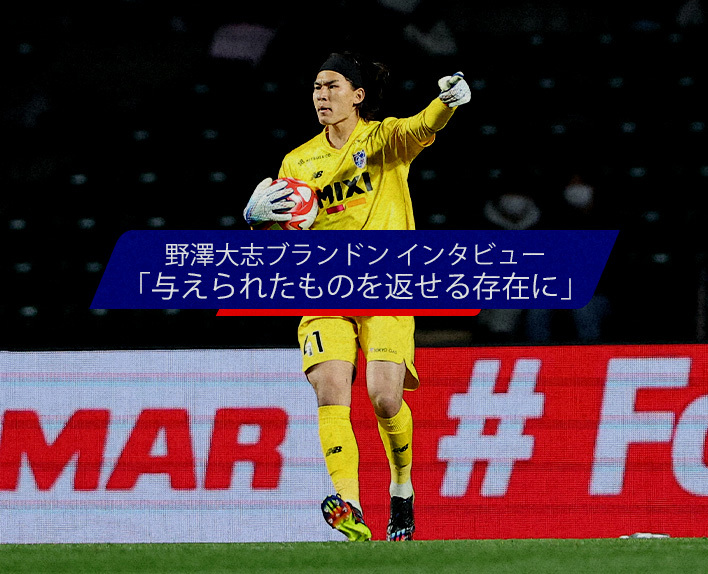


Q: You grew up in Okinawa until junior high school and came to Tokyo when you were in high school. You answered that you started aiming to become a professional soccer player at the age of 15, but was the reason for deciding to come to Tokyo to achieve your goal?
A: When I was thinking about my future path in junior high school, I had a strong desire to devote myself to soccer, so I joined the Tokyo academy, FC Tokyo U-18, which offered me a place. Since I was going to Tokyo, I decided that I would become a professional player by the time I graduated from high school.
Q: What did you think would be a positive impact on yourself by coming to Tokyo?
A: I considered being able to play for Tokyo's academy, a team belonging to the J1 League, to be a valuable asset for myself.
Q: Have you noticed any changes in yourself since moving from Okinawa to Tokyo?
A: In terms of soccer, professional players were practicing on the adjacent field, so I became more aware of the pros than before. The frequency of practice increased compared to when I was in junior high, and my life became centered around soccer. I remember practicing a lot with the mindset of "I have to do more." Outside of soccer, my Okinawan accent disappeared, and I started speaking with a Tokyo dialect.
Q: Did you feel a sense of tension when stepping onto the stage of the J-League in a particularly responsible position as a goalkeeper?
A: When I was playing in J3, I hadn’t fully organized my thoughts and was more focused on my own performance than on a sense of responsibility. I learned about the tension and pressure last season while playing for Iwate Grulla Morioka.
Q: Please tell us something you were confident about and something you considered a challenge when you were in high school.
A: What I was confident about was stopping shots and protecting the goal. Looking back now, I think my challenge was how I conducted myself as a goalkeeper. At that time, I wasn't aware of what kind of position a goalkeeper truly is, so I wish I had worked more on physical conditioning and other aspects.
Q, what changes have you experienced between your high school days and now?
A, my personality has changed about 180 degrees. I had more opportunities to interact with professional players, and I was taken care of by Akihiro HAYASHI, Tsuyoshi KODAMA, Go HATANO, and former goalkeeper coach Shinichi MORISHITA (currently Júbilo Iwata Academy GK Technical Coach), which led to changes in my greetings and language use. I was the youngest member to join the team, but I realized that the three senior goalkeepers were dedicating their lives to their playing careers, and I wanted to be like them. I thought it was disrespectful to behave without respect toward players with long careers, so I felt I had to change.
Q, Akihiro HAYASHI (currently Vegalta Sendai) was mentioned as a player influenced by the player profile on the website.
A, when I was promoted to the top team, I started in matches. I was also selected for the Best Eleven, which means I was alongside the best goalkeeper in Japan. I was able to feel Akihiro Hayashi’s personality up close. Training together, he was someone who ignited my passion, making me want to improve even more.
Q, in the 2021 season, contributed to the promotion to J2 League by going on loan to Iwate Grulla Morioka.
A, we finished second in J3 and were promoted to the J2 League. I don't truly feel that I accomplished it myself; rather, I felt that I was allowed to win. I am only grateful that the coach continued to use me. When we were promoted to the J2 League, I vaguely realized that I lacked the mentality and sense of responsibility required to play in matches. Although the fact of promotion may have made the outward appearance look good, I spent a lot of time facing myself in order to compete in the next season in the J2 League. That period helped me grow and taught me many things.
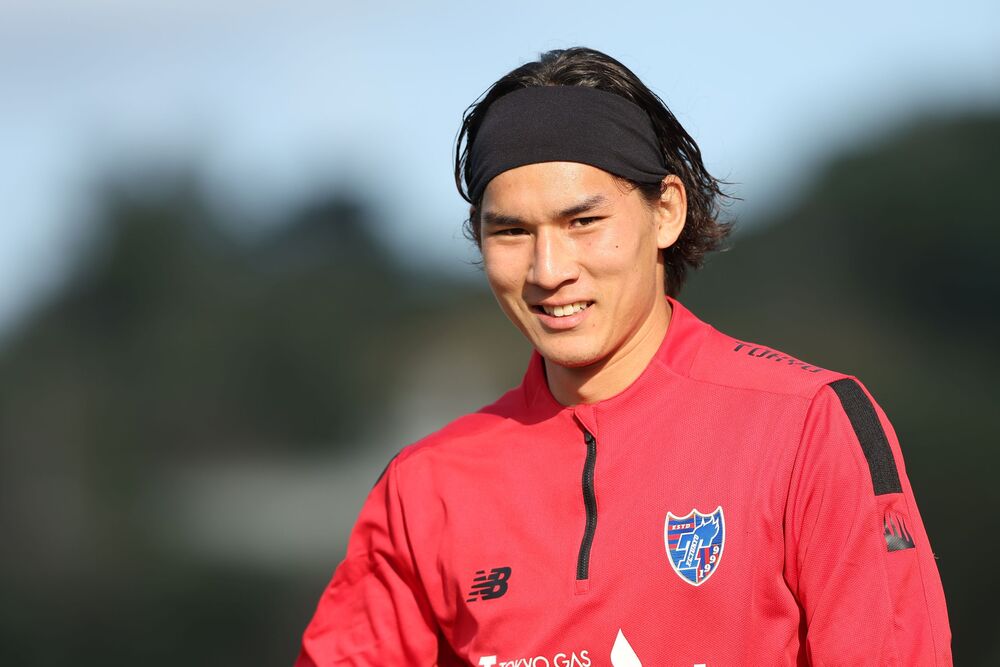
Q: What kind of impact did the experience in Iwate have on player Riku NOZAWA?
A, I believe the year when we were relegated from the J2 League to J3 was a period that helped me grow more than when we achieved promotion. It is true that the level of J3 is not as high compared to J1 and J2, and because we were winning in J3, I felt somewhat comfortable there. I faced the harsh reality in J2. Iwate is a developing team that wants to become better, so there is a lot of interaction with the local community. I felt that teammates, staff, stadium personnel, sponsors, and many others formed one community. I stand on the pitch representing everyone, so the feeling that I cannot be intimidated became my source of strength. With many people supporting us and some teammates unable to play, if the person representing the team behaves inappropriately, it would disregard everyone's feelings. Thinking about this brought out a sense of responsibility. Responsibility may not be something you can choose to have, but as you see more things, you might be able to take on responsibility. It was a tough period, but looking back now, it was an important time. I believe it is during difficult times that one’s heart is polished.
Q: Riku NOZAWA was the first player from Iwate to be selected for the Japan national team. How did you feel when you represented the team and became a member of the Japan national team?
A, the period I spent with the national team became a turning point for me. It was a proud title to be the team's first national team player, but at that time, I was so focused on myself that I couldn't see what was around me. Talking with Seiya Hamano, the national team goalkeeper coach, broadened my perspective. Rather than feeling like I was carrying Iwate on my back at the time, I realized later that I had been carrying Iwate. After my national team activities, I got injured, but because of the changes within me, I felt like I was starting to move forward.
Q, is player Nozawa the type to put pressure on himself during games? Or is he the type to get excited?
A, I think there is a big difference between a goalkeeper standing on the pitch carrying pressure and standing on the pitch feeling excited. Rather than focusing on my skills, I feel excited because of my desire to play in the match and win together with the team.
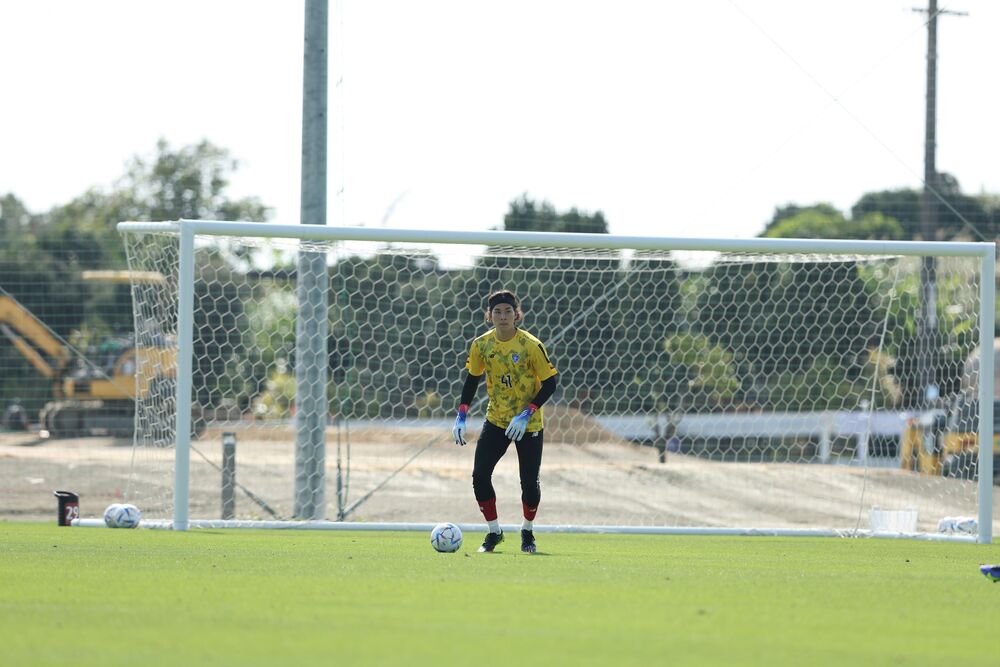
Q, Please tell us how you felt when you decided to return to Tokyo from this season.
A, I am filled with gratitude and a sense of indebtedness to Tokyo. I have always wanted to play in Tokyo and win titles. It was only after reflecting on my life in Iwate that I realized how much Tokyo has given me. I love Tokyo, so I was happy when I was approached.
Q, When you were approached, what did you think Tokyo was asking of player Nozawa?
A, I think they were asking me to stand at Ajinomoto Stadium as an academy graduate.
Q, How is the team atmosphere since joining?
A, Everyone is trying to approach the game by valuing what is in front of them. There are many players who want to improve, and everyone is living without regrets. It is a big thing for me to be able to play with such a team.
Q, Impressions of Jakub SLOWIK and Tsuyoshi KODAMA, and the atmosphere of the goalkeeper team.
A, I have been taken care of by KODAMA since before, and he still treats me well. I have also been able to build a good relationship with SLOWIK and I respect his mentality when facing matches. The atmosphere among the goalkeeper team, including the staff, is good and we are all aiming for higher goals regardless of who will play in the match. I am grateful to be a part of that.
Q, What kind of presence is Kashif BANGNAGANDE, who was promoted from the academy to the top team, and Seiji KIMURA, for Nozawa?
A, Kashif BANGNAGANDE has a clear vision for his future while burning with passion. Seiji KIMURA has a similar position to me, having left Tokyo and seen the outside world. I respect their strong determination to give their all for Tokyo.
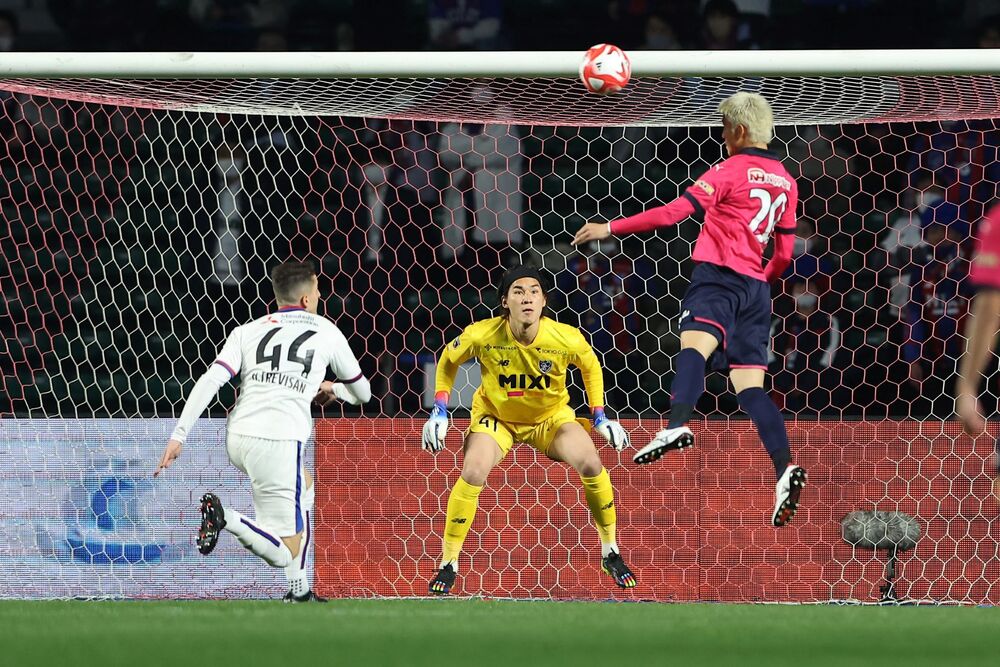
Q, Please tell us the team and individual goals for the 2023 season.
A, We are aiming for both team and individual championships. Personally, I believe that we must live in the present and focus on each day's practice in order to be successful. I want to approach each game with this mindset. Ultimately, I hope to achieve the championship, but I also value the process and believe that it is important to give our best effort and fight until the end, even if the results do not go our way.
Q: Please tell us about your strengths and points you want to appeal as a player, Nozawa.
A, I want to fulfill my responsibility as a goalkeeper by protecting the goal. When I play in a match, I want to demonstrate leadership so that everyone can work together to defend the goal.
Q: In response to the question of what is good about becoming a soccer player, Riku NOZAWA answered, "Being in a position to give dreams and hope to many people as a professional." What would you like to convey to the people around you, NOZAWA?
A, I want to give to many people what I have been given. I have come to understand how special professional soccer players are to children and the local community. I want to understand the position I have been given and expand a circle where everyone can share joy together.
Q: Do you have anything you want to tell children who dream of becoming professional soccer players?
A: Only a handful of players can become professionals, but it is natural to admire and aim for that, and I want everyone to do their best. I believe in valuing what is truly important in life, and I think it is a waste to be completely absorbed only in oneself. I want to take the time from now on to think about how to convey this well to children.
Q: Please give a comment to the fans and supporters regarding the upcoming league matches and Levain Cup.
A: Right now, the team is fighting with the mindset of improving and growing, and we are committed to winning every match in the style the coach aims for. Patience is necessary when things don’t go well for the team, and I believe there will be times when fans and supporters will need to be patient as well. We want to deliver soccer that is enjoyable to watch, exciting soccer, and victories as soon as possible.