

<Match Preview>
The “journey” of the 2022 season, which began on February 18, is now down to the last two matches.
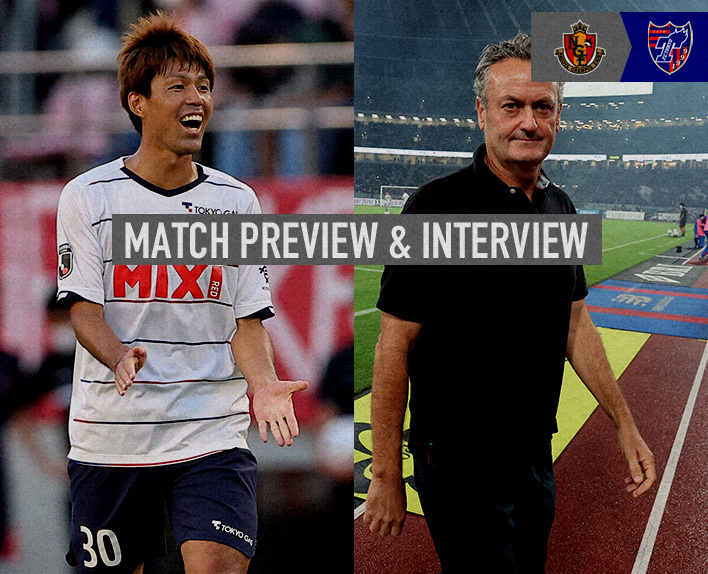
The final away game is against Nagoya Grampus. The team is led by Kenta HASEGAWA, who managed Tokyo for four seasons until last season. In the first half of the season, Tokyo was unable to score against the measures taken by the coach, who knows Tokyo’s players well, and the match ended 0-0.
The biggest threat to Tokyo is undoubtedly Kensuke NAGAI, who played for Tokyo until this summer. With his top-class speed in the J.League, goal-scoring instinct, and bright, beloved character, he was an important figure for Tokyo’s fans and supporters. However, this time he is the key player for Nagoya aiming for Tokyo’s goal. Like Coach Hasegawa, NAGAI is also very familiar with Tokyo’s players. How to stop him as he aggressively attacks with the support of the home crowd will be the key point in this match.
On the other hand, Tokyo's players are also well acquainted with Nagai. How Masato MORISHIGE will confront him, and how Yasuki KIMOTO, who was cherished as a junior in university, will stop Nagai's speed—these intense matchups will unfold, and ultimately, we hope the Tokyo center-back duo will successfully neutralize Nagai.
The opponent's defense is led by Yuichi MARUYAMA, who faces his former club. Against Tokyo's attack, which scored four goals in the previous match against Cerezo Osaka, Coach Hasegawa is expected to implement thorough countermeasures. Although Tokyo's build-up accuracy fluctuates depending on the match, when the opponent presses from the front, they want to calmly break the press. If the opponent reinforces their defensive block with numbers in their own half, Tokyo aims to skillfully shake them by moving the ball at a good tempo and seize any openings without hesitation.
A season of building a new Tokyo style through the “journey” with Albert PUIG ORTONEDA. As the finale, we will bring home 3 points with the football that “journeys with the ball” (Albert PUIG ORTONEDA).
[Albert PUIG ORTONEDA Interview]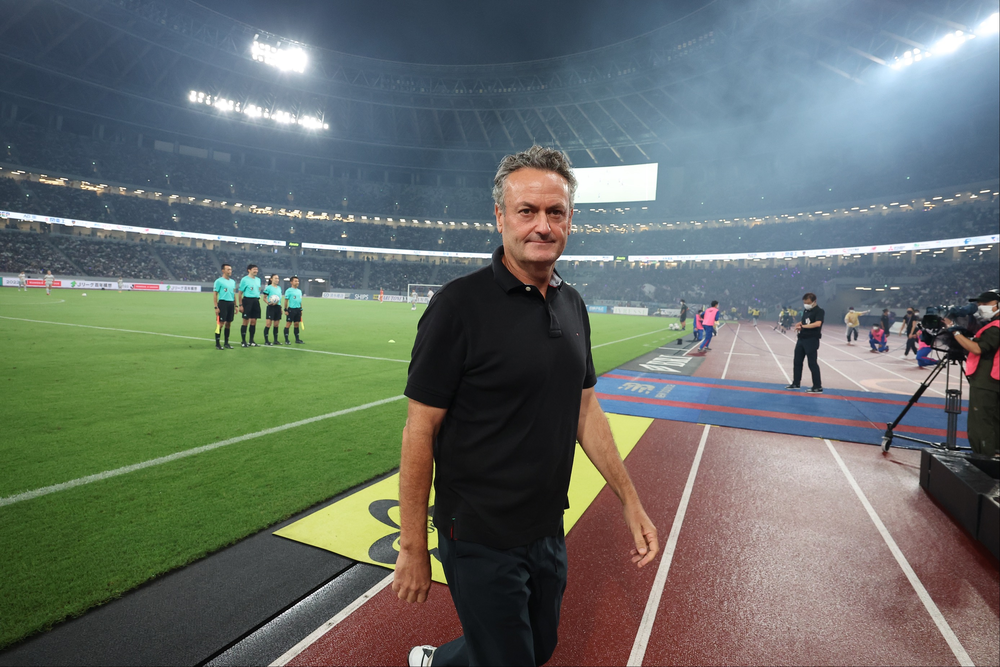
Q. There was a break in the league matches; how is the team's condition?
A. We were able to engage in good training. I think it was a two-week period during which various things progressed smoothly. Although things going well doesn’t guarantee a win in matches, I do have a good feeling. I strongly feel that the team is continuously growing steadily and is in good condition. However, each match is different, and since various factors influence the match results, you really have to play to know how it will turn out.
Q. At the beginning of the season, you mentioned that reaching about 50-60% of the new style this season would be good, but what percentage would you say it is now?
A. I believe we have reached about 60% of the level we are aiming for.
Q, what is the basis for that?
A. I feel that the current players have adapted well to this style. Naturally, I myself had to adapt to the characteristics of the players as well. As I mentioned previously, I never intended to do the same thing here as we did in Niigata. My aim was to do better work based on the players' characteristics. Of course, valuing possession of the ball is a non-negotiable part, but from there, we incorporated team tactics while taking the players' traits into account. As the first season of changing the style, I believe the players have adapted well and reached a good level. Our attacking play in tight spaces is also steadily improving, and it is important to continue that growth going forward. However, there is still 40% left to achieve, so there is much work to be done. We intend to keep making continuous efforts in that regard. Reaching this level in about eight months is something worthy of recognition. For example, Yokohama and Kawasaki, who are ranked above us, have been playing with this style for several years. We also need the same amount of time. I believe that as a club, by having all the fans and supporters join us on this journey, we will grow into a club worthy of winning the championship. I don't think there is any other secret to it.
Q, to fill the remaining 40%, you mentioned the distance between players during the recent practice. Will aspects like that become necessary?
A, Yokohama excels at playing in tight spaces. One very important concept is playing in narrow areas. In addition to that, making runs behind the defense is something we place great importance on. This is because we want to leverage the fact that many of our second-line players are good at making forward runs. If, for example, a player who is extremely skilled at close control joins next season, we will need to adapt the team tactics based on that player's characteristics. However, to develop good combinations in tight spaces, time is definitely necessary.
Q, heading into the Nagoya match, is maintaining possession important against teams that apply a high press?
A, the reason we want to build up from the goalkeeper is that if we can successfully break through against opponents who apply a high press from the front, it creates space behind them, increasing our chances to create opportunities. We are not connecting from the goalkeeper aiming for beautiful play. Teams that build up from the back against opponents who apply a high press inherently carry the risk of danger when the ball is lost. On the other hand, teams that apply a high press do so taking the risk of leaving large spaces behind, with the possibility of creating chances if they win the ball. I believe there is this kind of battle between the two teams.
Q, what did you think about Diego as an important presence as a foreign player this season?
A, I believe he contributed in two key ways. There are several reasons why his goal count decreased. One is that he had discomfort in his hip joint since the preseason and continued to play while enduring it, which was one factor. Additionally, if you look at the team's growth process, you can see that the team gradually improved and the number of chances increased. For example, Adailton is better at making runs into space. I think he had opportunities from the start of the season. As the team grew and had more chances to press the opponent, players like Watanabe, Leandro, and Diego had more goal-scoring opportunities. Because of various factors, Diego’s goal count likely decreased. Like Morishige, there is no doubt that Diego is a very important player for Tokyo. As vice-captain, it was crucial that he earned respect not only from foreign players but from all players through his past performances. Furthermore, there were several foreign players among the new signings. Diego was the one who cooperated more than anyone else to help them adapt well to the team.
[Player Interview]
<Yasuki KIMOTO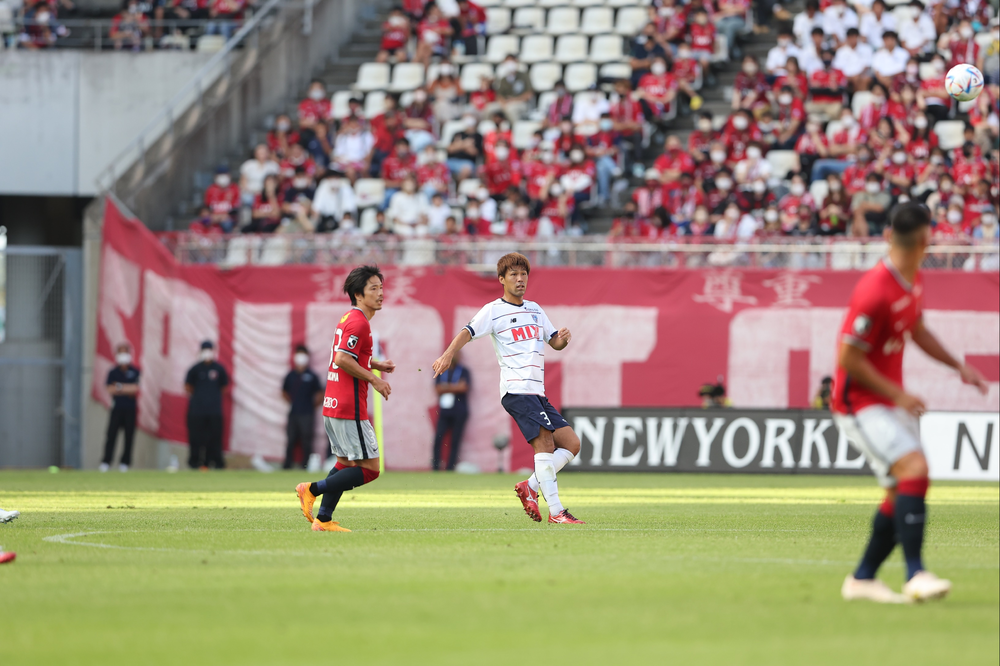
Q, What impression do you have about the match against your former club led by Kenta HASEGAWA?
A, my impression when we played against them was that everyone worked hard, and as a team, not a single player slacked off. In terms of offense, I was impressed by their fast attacks that made good use of the talents up front.
Q, I think this is a match at Toyota Stadium, which holds special meaning for you.
A, It’s a really great stadium, and since it can hold a large number of people, I think it creates a good atmosphere. I spent a year at Nagoya and experienced many good things, but on the other hand, I also went through a lot of hardships, so in that sense, I am grateful to the club. However, more than that, I have a strong desire not to lose, and I want to focus on competing to win.
Q, in a previous interview, you mentioned that thanks to Kensuke NAGAI you felt you could enjoy playing soccer. Was his presence during your time in Tokyo really significant?
A, Yes. Although he was a senior from university, I am very grateful that he helped me blend into the team just after I joined. He always told me to enjoy playing soccer, and I believe that is the reason I have been able to participate in matches up to now. I have such feelings of gratitude, but at the same time, I don’t want to be beaten, and I want to do whatever it takes to hold the defense.
Q, this time you will be matched up as an opposing player; how do you feel about that?
A, His speed is the fastest in Japan, and since I can't match him in speed, I think it's important to take position first and not be beaten by his speed.
Q, I think it is also important how to maintain possession of the ball and build up the attack against opponents who apply high pressure from the front line.
A, I think Nagai and the others will apply pressure on us from the front line. We have the impression that we haven’t been able to achieve good results against teams that press from the front, so we must overcome that. It’s not just about escaping with long balls; we have steadily built up the ability to connect from the back and use long balls when there is risk, so I think it will be important to switch between these approaches in the Nagoya match. While doing that properly, I want to calmly and carefully connect from the back and show what we have worked on throughout the year.
Q, how do you feel about looking back on yourself up to this point in the season with only 2 games left?
A, I have been starting in the league matches consistently, and this season has given me the most playing time in my career so far. I have been able to have a fulfilling season. For these last two games, I want to pursue both quality and results so that I can say this has been my best season yet.
Q: What kind of game do you want to play while being in a position to aim for the ACL?
A, we can aim for third place, but honestly, it also depends on other teams, so to reach that position, we have no choice but to win the next two matches. That said, I won’t worry too much about it and will focus on both the content and results of the remaining two games to finish the year on a high note.